
There are moments in wildlife photography when the animal finds you before you find it. This was one of those moments.
I had been crouching low in the grass for nearly forty minutes, camera resting on a folded jacket, watching nothing in particular. The light was doing something rare — that flat, even gold that arrives in late afternoon and makes everything look slightly unreal, like a memory of a place rather than the place itself. The grass was wet from the previous night. My knees were soaked through.
Then, at the far left edge of my frame, something moved.
Not a bird. Not a rustle. A deliberate, purposeful movement — the kind that belongs to an animal that knows exactly where it is going and is in no particular hurry to get there.
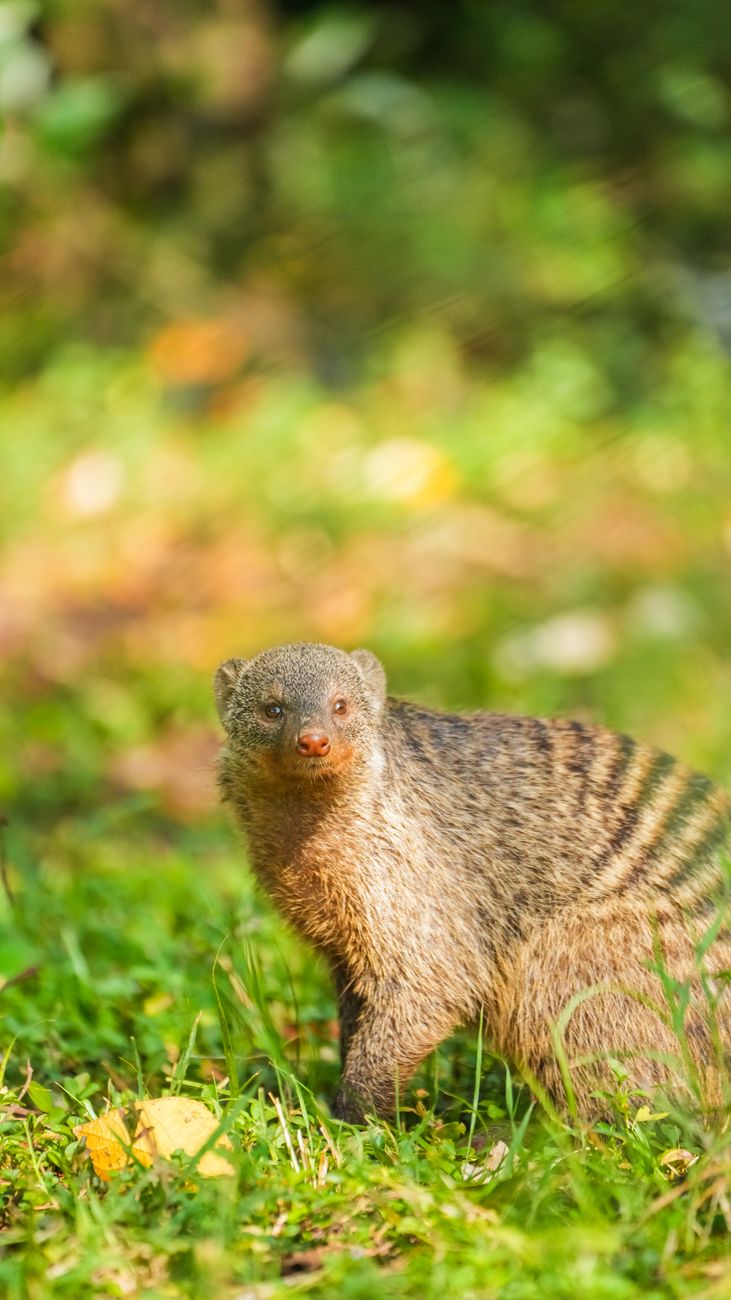
It was a mongoose. Small, rust-brown, with a pointed snout and eyes like polished black glass. It emerged from beneath a tangle of grass roots, paused for exactly one second at the edge of open ground, and then sat upright — alert, scanning, completely still.
I did not breathe.
The Animal Itself
The small Indian mongoose — Herpestes javanicus — is one of those creatures that everyone knows and almost no one actually looks at. It appears in folklore, in Kipling, in the word “Rikki-Tikki-Tavi.” It has been introduced to islands across the world to control snakes and rats, often with catastrophic consequences for local wildlife. In parts of Hawaii and Fiji, it is considered a pest. In India, it is simply part of the landscape — as ordinary and overlooked as a crow or a house sparrow.
But ordinary is a word that falls apart under close inspection.
Up close, the mongoose is a remarkable piece of biological engineering. The body is long and low, built for moving through dense undergrowth without announcing itself. The legs are short but powerful. The tail, nearly as long as the body, acts as a counterbalance during rapid direction changes — which happen constantly, because the mongoose rarely moves in a straight line for more than a few seconds. Everything about its shape says: I was built for tight spaces and fast decisions.
The face is what stays with you. The snout is narrow and twitching, processing smell information at a rate that makes our own noses seem like blunt instruments. The ears are small and rounded, set back and low on the skull — designed to fold flat when the animal pushes through dense grass. And the eyes are dark, deep, and intensely focused. There is a quality to those eyes that is hard to describe without sounding dramatic. They look at you as if they are measuring something.
This one was measuring me.
What the Camera Sees
The first photograph was taken through grass. The mongoose was partially obscured — only the head and upper body visible above the stems, the rest hidden in the undergrowth behind it. This is not a limitation. This is the truth of the animal’s world.
The mongoose lives at ground level, in the space between things. It moves through the gaps in grass, between rocks, under logs. Its entire existence is structured around partial concealment — not hiding exactly, but never being fully exposed either. Even when it sits in the open, it positions itself so that retreat is always one movement away.
In the photograph, the late afternoon light catches the fur along the animal’s back and shoulders, turning the normally drab brown coat into something richer — amber at the edges, dark chocolate at the spine, with a faint reddish undertone where the sun hits directly. The whiskers are visible, catching light like fine wire. One eye is sharp and alert, fixed on something to the left of frame. The posture is that of an animal mid-assessment — not alarmed, not relaxed, but in the precise middle state between the two.
Behind it, the background dissolves into warm bokeh — brown and amber tones that echo the animal’s own colouring, as if the grass has grown specifically to camouflage this particular creature. Which, in a sense, it has.
The Second Encounter
Ten minutes after the first sighting, after I had carefully shifted position to improve my angle, the mongoose reappeared on a fallen log at the edge of a small clearing.
This time there was no grass between us.
It was higher up, its head and chest visible above the log’s edge, the rest of its body out of sight. The posture was different here — more deliberate, almost formal. The way a sentry stands when it knows it is being watched but has decided that being watched is acceptable, at least for now.
The second photograph captures this moment with unusual clarity. The face fills most of the frame — the pointed snout, the single visible eye, the short rounded ear. The fur on top of the head catches direct sunlight and glows slightly at the edges. The eye is sharp and fully in focus, dark and reflective, with a tiny catchlight that gives it an unlikely depth.
What strikes me looking at the image now is the expression — if you can call it that. There is no fear in it. There is no aggression. There is only attention, pure and complete. The mongoose is looking at something with its entire being. Whatever it is calculating, it is doing so with full commitment.
I have photographed many animals. Most of them give you a fraction of a second before they are gone. This mongoose gave me nearly three minutes.
Why the Mongoose Matters
The small Indian mongoose is not endangered. It does not appear on conservation watch lists. It is not the subject of major fundraising campaigns or documentary series. It is, by most measures, doing fine.
This is itself worth noting. In an era when wildlife photography increasingly functions as conservation advocacy — when every image is implicitly an argument for saving something — there is a particular honesty in photographing an animal that does not need saving. The mongoose is not a symbol of loss. It is a symbol of persistence.
It has been living alongside humans for thousands of years. It has adapted to agricultural land, to village edges, to the disturbed scrub that exists in the margins between farmland and forest. It eats rodents, insects, lizards, frogs, eggs, and the occasional snake. It occupies the ecological role of medium-sized predator in habitats where larger predators have long since disappeared. In many places, it is the only thing keeping rodent populations in check.
And it does all of this without requiring wilderness. Without requiring pristine habitat. Without requiring anything from us except that we do not actively pursue it.
There is something instructive in that.
The Light, the Grass, the Moment
Wildlife photography is often talked about in terms of patience — the long wait, the cold morning, the hours of nothing followed by one moment of everything. This is accurate, but it misses something.
The waiting is not empty. The waiting is when you learn to read the landscape. You learn which patches of grass move in wind and which move because something is walking through them. You learn the difference between the silence before nothing and the silence before something. You learn to keep your hands still even when your legs are cramped, because the mongoose — or the deer, or the bird, or whatever it is you are waiting for — will feel the shift in your weight before it sees you.
On this particular afternoon, I had not been waiting for a mongoose. I had not been waiting for anything specific. I was there because the light was good and the grass was interesting and sometimes that is enough of a reason.
The mongoose arrived and stayed and looked at me and left. It had its own itinerary, its own agenda, its own understanding of the afternoon that had nothing to do with mine. For three minutes, those two understandings briefly overlapped.
That is what the photographs are. Not a record of something rare. Not evidence of a conservation success or failure. Just documentation of an overlap — two creatures in the same patch of grassland at the same time, each trying to figure out what the other was.
On Being Looked At
There is a specific feeling that comes when a wild animal looks directly at you and does not run.
It is not flattery. The animal is not choosing you. It is assessing whether you are a threat, calculating risk, running some version of a cost-benefit analysis that has been refined over millions of years of evolution. The stillness in its gaze is not calm — it is computation.
But knowing this does not make it feel any less like contact.
When the mongoose on the log turned its head and looked directly into my lens, I felt, briefly, that something was being communicated. Not a message exactly — animals do not send messages. But a recognition, perhaps. An acknowledgement that two different kinds of awareness were occupying the same space, and that this fact was, in some small way, notable.
Then it dropped back behind the log and was gone.
I stayed in the grass for another hour, hoping it would come back. It did not. But I found myself thinking about those three minutes for a long time afterward — the way the light had caught the fur, the quality of attention in those dark eyes, the way the animal had seemed completely at home in a world that I was only visiting.
What Stays
I have looked at the photographs many times since that afternoon. They hold up.
Not because they are technically perfect — they are not. The first image has some foreground blur that clips the snout slightly. The second is slightly underexposed in the shadow areas under the log. These are minor things, but they are real.
What holds up is the quality of the moment itself. The mongoose on the log, seen from ground level, against a blurred green background, with the late light on its face — this is an image that does not need explanation. You look at it and you understand, immediately, that something alive was here and that it was worth paying attention to.
That is, ultimately, what wildlife photography is for. Not spectacle. Not rarity. Not the dramatic moment of predation or the once-in-a-lifetime sighting. Just the steady, honest work of paying attention to other lives, and the occasional grace of having them pay attention back.
The mongoose in the grass. The mongoose on the log. Two frames, one afternoon, one animal going about its business in a world it has always known better than we have.
All photographs taken in natural light, with no baiting, no calling, and no disturbance to the animal’s behaviour.
Leave a Reply